Quince Fruit Extract

Pyrus Cydonia Fruit Extract

Antimicrobial properties of quince

A study of the alcohol extract of quince seeds showed its antibacterial activity against St. Aureus, E. Coli, St. Epidermidis. The extract suppresses gram-positive microflora to a greater extent than gram-negative. The antibacterial effect of the extract is associated with the presence of tannins in its composition. Tannins precipitate microbial proteins, thus leading to a deficiency of nutrition and arrest of growth of sensitive bacterial species. In studies by Fattouch et al.1, the antibacterial properties of quince peel extract were identified and the minimum inhibitory and bactericidal concentrations of the extracted polyphenols were determined.

Alizadeh et al. studied the fungicidal properties of the extract against Aspergillus niger2. The results demonstrated that quince fruit extract can inhibit the growth of A. niger.

Anti-allergic properties of quince

The prevalence of allergies in the modern world is steadily growing under the influence of many factors. The combination of genetic features of the immune response with environmental pressure factors such as allergens, infections and pollution deserves special attention. One of the directions in the development of modern allergology is the search for an alternative to traditional anti-allergic therapy using corticosteroids and antihistamines. Today, one of the lines of research is the study of the mechanisms of anti-allergic properties among nutraceuticals, primarily those rich in polyphenols3.

Shinomiya F. et al. studied the effect of a simple aqueous extract of quince fruit on a type I allergic reaction in a model of atopic dermatitis in NC/Nga mice. It was established that the introduction of quince into the diet of rats allowed a significant reduction in the manifestations of atopic dermatitis. The authors suggest that the antihistamine effect is realized through a previously undescribed mechanism of action, since in the experiment no correlation was observed between the level of IgE in blood plasma and the severity of dermatitis manifestations. In an in vitro study on an NC/Nga cell culture model (mast cells with high sensitivity to IgE), an inhibitory effect of quince on IgE production and IgE-dependent degranulation was established4.

High-molecular-weight fractions of quince reduce the expression of messenger RNAs of high-affinity IgE receptors. In a dose-dependent manner, quince extract suppresses the production of IL-13 and tumor necrosis factor. Studies have also confirmed the suppression of histamine release by bone marrow cells. At the same time, the authors draw attention to the absence of changes in cell proliferation and cell viability5.

The pronounced antihistamine properties of quince have also been studied in humans. The use of the fruit extract in nasal drops for allergic rhinitis allows a significant reduction in the manifestations of allergic rhinitis6.

Other beneficial properties of quince

There are experimental data confirming the positive effect of quince fruits on the cardiovascular and urinary systems, high antioxidant activity, a positive effect on glucose utilization in diabetes mellitus, in diseases of the cardiovascular system, especially in atherosclerosis, and, when used topically, it accelerates wound healing.

Chemical profile

For medical purposes, all parts of the plant are used. Quince is rich in polyphenols, especially proanthocyanidins. To date, 26 polyphenolic compounds of quince have been identified and characterized. The highest content of polyphenols is found in the leaves.

Quince fruits are used for food both fresh and after culinary processing. They are juicy and have an unusually pleasant aroma. Recently, due to their bright and characteristic aroma, quince fruits have found application as raw material for the manufacture of natural food flavorings.

The fruits contain at least six types of fruit acids: citric, ascorbic, malic, quinic, shikimic, and fumaric. In some samples, oxalic acid was detected. Quince fruits are rich in carbohydrates, which account for 7–16%, with pectin about 4%. They also contain vitamins B1 and C; tannins 0.6–1%; the essential oil contains terpenes: limonene, linalool, citral, α-terpineol, γ-3-carene, trans-β-farnesene; dodecane; alcohols: methanol, ethanol, benzyl, 2-phenylethyl, etc.; aldehydes and ketones; steroids: sitosterol, saringosterol; proanthocyanidins; higher aliphatic hydrocarbons: tricosane, pentacosane, heptacosane, nonacosane; higher aliphatic alcohols: docosanol, tetracosanol, heptacosanol, nonacosanol; higher fatty acids: palmitic, oleic, linoleic, myristic, stearic.

Toothpastes with quince fruit extract for babies
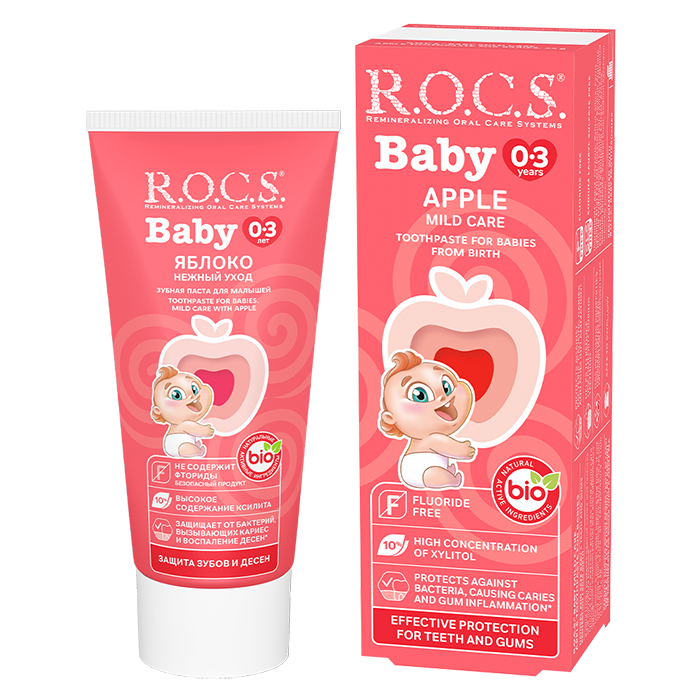
Apple
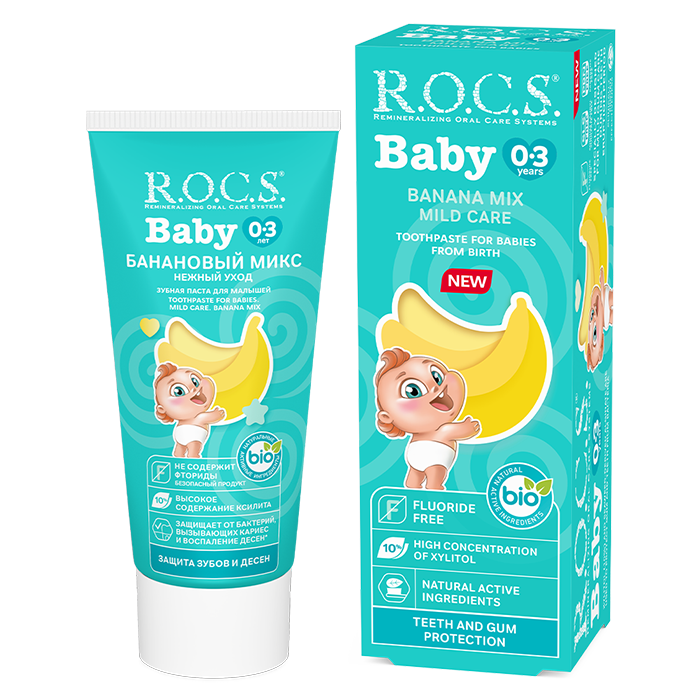
Banana Mix
Apple
Apple
Banana Mix
Banana Mix

Description

Active ingredients

Properties

RIA

Clinical trials

Ingredients

Application

Features

The unique toothpastes in the R.O.C.S. Baby line are designed for oral care in babies from the earliest age. The combination of xylitol and kelp-derived potassium alginate helps rebalance the oral microbiome and restore the mucosa after teething.

The formula is enhanced with plant extracts of quince fruit, Japanese honeysuckle, and Caprifol honeysuckle flowers.

Indications

  • Regular oral care for children from 0 to 3 years.
  • Reducing inflammation and pain during teething.
  • Caries prevention starting with the first tooth.

Organoleptic properties

The toothpaste has a low-foaming formula to help prevent gagging during brushing. The texture is gel-like, and the color is cream.

Available in three bright flavors: banana, apple, and apple-strawberry.

Alginate — a polysaccharide from seaweed — holds moisture on the mucosal surface, absorbs toxins, prevents pathogenic bacteria and fungi from attaching, and supports reparative processes.
Xylitol 10% inhibits the activity of cariogenic bacteria and some periodontopathogens and prevents the adhesion of Candida fungi.
Quince fruit extract, rich in polyphenols, has antihistamine, immunomodulatory, and antibacterial properties.
Japanese honeysuckle and Caprifol honeysuckle flower extracts have a wide range of antimicrobial effects, inhibit lipopolysaccharide-induced reactions, have a tissue-protective effect, and act as a natural preservative.

  • Reduces teething discomfort.
  • Promotes mucosal healing.
  • Protects against bacteria that cause caries and gum inflammation.
  • Normalizes the oral microflora.
  • Safe if swallowed.

RIA<15 (Care for children 0–3 years)

* Russian Abrasivity Index reflects the cleaning capacity level of oral care products and polishing pastes. Products with a higher RIA value have enhanced cleaning properties, but are also a risk factor for the development of non-carious dental lesions, therefore the choice of toothpaste should be guided by the condition of the hard dental tissues.

Russian Abrasivity Index (RIA): a new stage in oral hygiene standardization

The DRC group of companies, in collaboration with the Institute of Digital Dentistry of the RUDN Medical Institute, has developed and is implementing a new toothpaste abrasivity measurement standard in Russia that meets the highest requirements: safety, accuracy, reproducibility. Принято. This methodology is an alternative to the RDA measurement method and offers a number of advantages. Its effectiveness has been confirmed by a large-scale experimental and clinical study involving 534 patients.

The methodology is based on a rotary machine and digital technologies developed by a research group of dentists, physicists, and digital modeling specialists. QLF diagnostics, intraoral scanning, and digital analysis were used in the work, which made it possible to obtain objective data on tooth wear and the influence of abrasivity over time.

Download RIA research protocol (in Russian):

More detailed information on the Russian Abrasivity Index (RIA)

Confirmation of prebiotic and anti-adhesive properties (normalization of microflora, protection against cariogenic bacteria and Candida fungi):

Effectiveness of the alginate-xylitol complex for treating mucositis, normalizing microflora, and protecting against Candida fungi:


The toothpastes differ only in their flavor components; otherwise, their formulations are identical:

Banana mix

Aqua, Glycerin, Xylitol, Silica, Pyrus Cydonia Fruit Extract, Potassium Alginate, PEG-40 Hydrogenated Castor Oil, Lonicera Japonica Extract, Lonicera Caprifolium, Aroma, Sodium Benzoate, Xanthan Gum, Sodium Saccharin, Cinnamal, Eugenol.

Apple

Aqua, Glycerin, Xylitol, Silica, Pyrus Cydonia Fruit Extract, Potassium Alginate, PEG-40 Hydrogenated Castor Oil, Lonicera Japonica Extract, Lonicera Coprifolium Extract, Aroma, Sodium Benzoate, Potassium Sorbate, Xanthan Gum, Sodium Saccharin.

Use twice a day (morning and evening) with a small-headed children's toothbrush. Recommended toothbrushing time is 2-3 minutes.

Use within one month of opening.

Apple
Apple

Toothpastes with bright flavors for babies from 0 to 3 years.
Enhanced gum protection and relief from teething discomfort.

Banana Mix
Banana Mix

Toothpastes with bright flavors for babies from 0 to 3 years.
Enhanced gum protection and relief from teething discomfort.