Description
Active ingredients
Properties
RIA
Clinical trials
Ingredients
Application
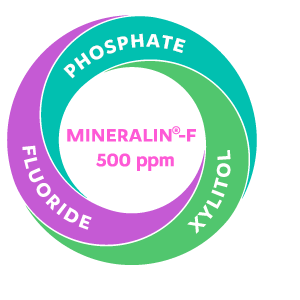
Fluoride toothpastes in the R.O.C.S. Kids 4-7 line are designed for oral care in children from age four, once a child can spit out the toothpaste after brushing. The fluoride content is 500 ppm. The toothpaste's gentle base provides thorough cleaning.
The appealing flavors were developed with children's preferences in mind to give them extra motivation.
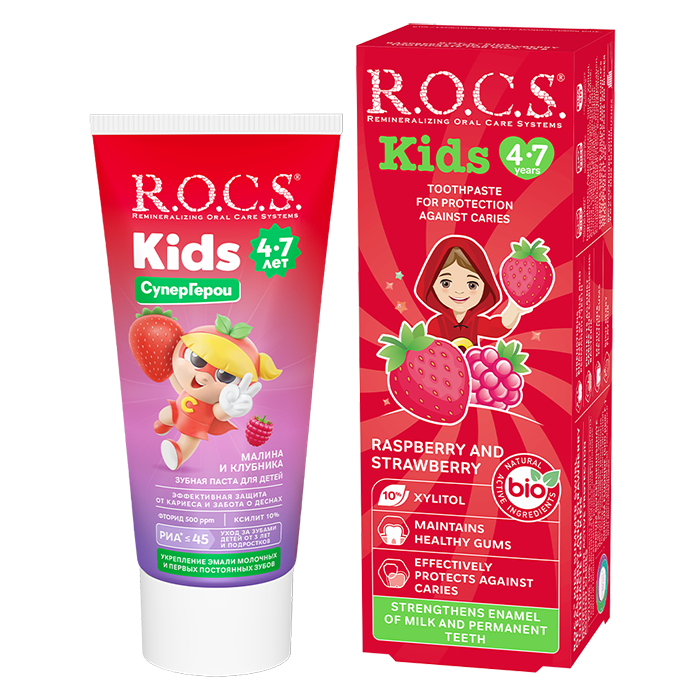
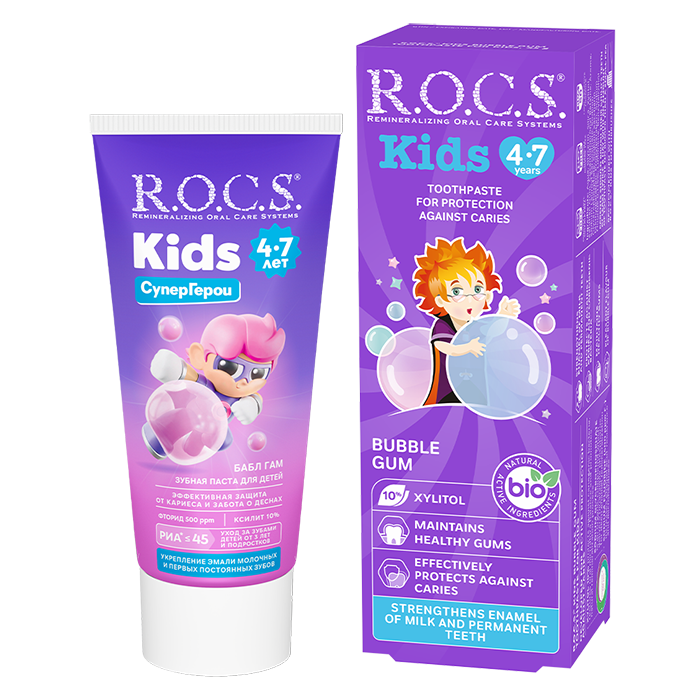
A cream-colored toothpaste. Available in two flavors: a mix of raspberry and strawberry and the taste of the popular chewing gum.
* Russian Abrasivity Index reflects the cleaning capacity level of oral care products and polishing pastes. Products with a higher RIA value have enhanced cleaning properties, but are also a risk factor for the development of non-carious dental lesions, therefore the choice of toothpaste should be guided by the condition of the hard dental tissues.
The DRC group of companies, in collaboration with the Institute of Digital Dentistry of the RUDN Medical Institute, has developed and is implementing a new toothpaste abrasivity measurement standard in Russia that meets the highest requirements: safety, accuracy, reproducibility. Принято. This methodology is an alternative to the RDA measurement method and offers a number of advantages. Its effectiveness has been confirmed by a large-scale experimental and clinical study involving 534 patients.
The methodology is based on a rotary machine and digital technologies developed by a research group of dentists, physicists, and digital modeling specialists. QLF diagnostics, intraoral scanning, and digital analysis were used in the work, which made it possible to obtain objective data on tooth wear and the influence of abrasivity over time.
More detailed information on the Russian Abrasivity Index (RIA)The combination of fluoride and xylitol has enhanced anti-caries properties:
The aim of this study was to investigate the effect of a toothpaste containing fluoride and xylitol on the remineralization of human enamel using quantitative light-induced fluorescence (QLF).
Artificial subsurface demineralization windows (2 mm x 3 mm) were created on longitudinally sectioned human extracted tooth specimens (three to four sections per tooth) using a special solution. The specimens were then randomly divided into 4 groups.
Each enamel specimen was treated for 3 min at 25 °C twice a day for 14 consecutive days with a silica-based toothpaste slurry:
Afterwards, the specimens were rinsed and placed in a remineralizing solution at 37 °C.
Changes in mean fluorescence loss (F), demineralization window size, and ΔQ values in group 3 were significantly greater compared to the other groups (P < 0.05).
baseline
day 3
day 7
day 14
The results obtained suggest that the inclusion of xylitol in a fluoride toothpaste may be beneficial for enhancing remineralization in vivo.
A large-scale long-term study compared the anti-caries effect of two dentifrices on a dicalcium phosphate dihydrate base. The dentifrice containing sodium monofluorophosphate (1100 ppm F) and 10% xylitol demonstrated a caries increment reduction of more than 10% compared to the dentifrice containing sodium monofluorophosphate (1100 ppm F) alone.
Three thousand three hundred ninety four (3,394) school children aged 7–12 years were selected from 28 public schools in the central plateau of Costa Rica to participate in this double blind clinical caries study. Children accepted for participation were stratified into two groups balanced by age and sex:
The study was conducted in harmony with the guidelines for caries clinical studies published in 1988 by the Council on Dental Therapeutics of the American Dental Association, and employed clinical diagnostic criteria provided in the 1991 guidelines published by the National Institute of Dental Research (NIH/NIDR). Dental radiographs were not employed.
Caries increment was assessed by calculating changes in the DFS (decayed and filled surfaces) and DFT (decayed and filled teeth) indices.
Table 1. Caries increment over the 30-month study period
|
Test group 1100 ppm F + 10% xylitol |
Positive control 1100 ppm F |
|
|---|---|---|
| Δ DFS | 1.30 | 1.51 |
| Δ DFT | 0.69 | 0.81 |
For both DFS and DFT, the increments associated with the test dentifrice containing 10% xylitol were statistically significantly lower than those associated with the dentifrice without xylitol (P < 0.05).
Evidence of the prebiotic and anti-adhesive properties of xylitol (normalization of microflora, protection against cariogenic bacteria and Candida fungi):
The high prevalence of caries in young children necessitates the use of therapeutic and preventive products that target the primary etiopathogenetic factor of this disease — pathogenic microflora. This study presents comparative data on the antimicrobial effectiveness of products containing xylitol and chlorhexidine, as well as their effect on the microbiocenosis composition of the dental biofilm.
A total of 30 patients aged 12 to 36 months with early childhood caries (18 boys and 12 girls) were followed for one month. The patients were divided into two equal groups using a blinded method:
It was recommended that the remineralizing gels be applied 4–5 times a day after toothbrushing. All procedures were performed by the patients' parents at home after receiving prior instruction.
At baseline and at the end of the prescribed treatment course, all patients underwent molecular biology testing using multiplex PCR at the NIMSI laboratory.
In group 1, a significant reduction in colonization by cariogenic species was detected, along with a positive effect of the R.O.C.S. Medical Minerals remineralizing gel components on the ratio of cariogenic to resident species, as well as a decrease in the quantity and frequency of detection of certain periodontopathogenic anaerobic bacteria (Table 1). An important positive feature of the change in the dental biofilm microbiocenosis composition in the first group was also the disappearance of Candida fungi.
Examination of the microbial flora of dental plaque in group 2 patients one month after treatment showed only some positive shifts in the ratio of cariogenic to normal flora, and a decrease in the frequency of detection of certain virulent strains. At the same time, the quantity and frequency of detection of representatives of the resident bacterial group — enterococci — decreased. In addition, the detection rate of the yeast-like fungus Candida albicans increased, with a statistically significant rise in the fungal colonization of dental plaque. These data indicate the development of dysbiosis with the use of chlorhexidine.
Table 1. Comparative assessment of changes in the frequency of detection of microbial flora in dental plaque between the two groups after a course of therapy
| Genus, species of bacteria | 0.1% chlorhexidine | R.O.C.S. Medical Minerals with xylitol |
|---|---|---|
| Streptococcus mutans (cariogenic strain) | no change | 45.4% reduction |
| Actinomyces spp. (cariogenic strain) | 33.3% reduction | 44.5% reduction |
| Veillonella parvula (resident) | 24.7% increase | 40.2% increase |
| Porphyromonas gingivalis (periodontopathogen) | 66.5% reduction | no change |
| Prevotella melaninogenica (virulent strain) | 20% increase | 44.5% reduction |
| Fusobacterium nucleatum (periodontopathogen) | 4.8-fold increase | 33.5% reduction |
| Candida albicans (fungus, pathogen) | 49.8% increase | complete disappearance |
A clinical examination after one month showed no new carious cavities or demineralization foci in group 1 patients; existing chalky spots regained their luster; the progression of carious defects was halted; and signs of catarrhal gingivitis disappeared.
During the clinical examination of group 2 patients, no new carious cavities were recorded either; the disappearance of catarrhal gingivitis signs was observed in 80% of patients (of those who had it at baseline).
The inclusion of both xylitol and chlorhexidine as antimicrobial therapy in the comprehensive treatment plan for early childhood caries leads to a reduction in the detection frequency and colonization level of cariogenic and periodontopathogenic flora in dental plaque.
The data presented indicate a more physiological action of xylitol; it has a positive effect on the microbiocenosis composition of the dental biofilm, normalizing the qualitative (species) composition and the quantitative bacterial load of both cariogenic and stabilizing resident species.
Very few substances are known today that can significantly affect the caries-causing environment in the mouth and reduce the risk of tooth decay. One of the most widely studied substances with an anti-caries effect is xylitol. However, the antibacterial mechanism of xylitol is not fully understood. This study provides data confirming xylitol's ability to significantly inhibit the adhesion of oral streptococci, the primary formers of dental plaque. These bacteria delay the development of caries- and periodontal disease-causing bacteria on tooth surfaces through a mechanism called co-adhesion. We also revealed the ability of xylitol to inhibit the adhesion of Streptococcus sobrinus, a microorganism associated with caries, and Staphylococcus aureus, which increases the virulence level of dental plaque. This mechanism of action is realised in toothpaste within the time period traditionally recommended for brushing teeth.
Confirmation of hypoallergenicity:
The article deals with the findings in the evaluation of the allergenic properties of "R.O.K.S." lime toothpastes for infants under 3 and "R.O.K.S." raspberry and strawberry toothpastes for children aged between 4 and 7 years old based on the adequate model of the animals with the contact dermatitis by means of the passive skin anaphylaxis. The authors proved that both toothpastes did not have any allergenic effect and may be recommended for application among children disposed to allergic reactions.
Aqua, Glycerin, Silica, Xylitol, Xanthan Gum, Cocamidopropyl Betaine, Aroma, Sodium Lauroyl Sarcosinate, Sodium Glycerophosphate, Sodium Saccharin, Methylparaben, Propylparaben, Sodium Fluoride (500 ppm), Benzylalcohol.
Brush twice a day (morning and evening) with a children's toothbrush. Use a pea-sized amount of toothpaste. Recommended toothbrushing time is 2-3 minutes.
After brushing, the remaining toothpaste should be spit out. If a child hasn't yet learned to spit out toothpaste and rinse their mouth, it's better to use a fluoride-free toothpaste. This toothpaste should also be avoided:
Preschool children should brush their teeth under adult supervision.
If a child is fussy and refuses to brush, themed rhymes and riddles can help.
To help your child get into a regular oral hygiene routine, print out the toothbrushing calendar, where the child can color in the boxes themselves after each brushing. Use colorful pencils.

Fluoride toothpastes in the R.O.C.S. Kids 4-7 line are designed for oral care in children from age four, once a child can spit out the toothpaste after brushing. The fluoride content is 500 ppm. The toothpaste's gentle base provides thorough cleaning.
The appealing flavors were developed with children's preferences in mind to give them extra motivation.
A cream-colored toothpaste. Available in two flavors: a mix of raspberry and strawberry and the taste of the popular chewing gum.
* Russian Abrasivity Index reflects the cleaning capacity level of oral care products and polishing pastes. Products with a higher RIA value have enhanced cleaning properties, but are also a risk factor for the development of non-carious dental lesions, therefore the choice of toothpaste should be guided by the condition of the hard dental tissues.
The DRC group of companies, in collaboration with the Institute of Digital Dentistry of the RUDN Medical Institute, has developed and is implementing a new toothpaste abrasivity measurement standard in Russia that meets the highest requirements: safety, accuracy, reproducibility. Принято. This methodology is an alternative to the RDA measurement method and offers a number of advantages. Its effectiveness has been confirmed by a large-scale experimental and clinical study involving 534 patients.
The methodology is based on a rotary machine and digital technologies developed by a research group of dentists, physicists, and digital modeling specialists. QLF diagnostics, intraoral scanning, and digital analysis were used in the work, which made it possible to obtain objective data on tooth wear and the influence of abrasivity over time.
More detailed information on the Russian Abrasivity Index (RIA)The combination of fluoride and xylitol has enhanced anti-caries properties:
The aim of this study was to investigate the effect of a toothpaste containing fluoride and xylitol on the remineralization of human enamel using quantitative light-induced fluorescence (QLF).
Artificial subsurface demineralization windows (2 mm x 3 mm) were created on longitudinally sectioned human extracted tooth specimens (three to four sections per tooth) using a special solution. The specimens were then randomly divided into 4 groups.
Each enamel specimen was treated for 3 min at 25 °C twice a day for 14 consecutive days with a silica-based toothpaste slurry:
Afterwards, the specimens were rinsed and placed in a remineralizing solution at 37 °C.
Changes in mean fluorescence loss (F), demineralization window size, and ΔQ values in group 3 were significantly greater compared to the other groups (P < 0.05).
baseline
day 3
day 7
day 14
The results obtained suggest that the inclusion of xylitol in a fluoride toothpaste may be beneficial for enhancing remineralization in vivo.
A large-scale long-term study compared the anti-caries effect of two dentifrices on a dicalcium phosphate dihydrate base. The dentifrice containing sodium monofluorophosphate (1100 ppm F) and 10% xylitol demonstrated a caries increment reduction of more than 10% compared to the dentifrice containing sodium monofluorophosphate (1100 ppm F) alone.
Three thousand three hundred ninety four (3,394) school children aged 7–12 years were selected from 28 public schools in the central plateau of Costa Rica to participate in this double blind clinical caries study. Children accepted for participation were stratified into two groups balanced by age and sex:
The study was conducted in harmony with the guidelines for caries clinical studies published in 1988 by the Council on Dental Therapeutics of the American Dental Association, and employed clinical diagnostic criteria provided in the 1991 guidelines published by the National Institute of Dental Research (NIH/NIDR). Dental radiographs were not employed.
Caries increment was assessed by calculating changes in the DFS (decayed and filled surfaces) and DFT (decayed and filled teeth) indices.
Table 1. Caries increment over the 30-month study period
|
Test group 1100 ppm F + 10% xylitol |
Positive control 1100 ppm F |
|
|---|---|---|
| Δ DFS | 1.30 | 1.51 |
| Δ DFT | 0.69 | 0.81 |
For both DFS and DFT, the increments associated with the test dentifrice containing 10% xylitol were statistically significantly lower than those associated with the dentifrice without xylitol (P < 0.05).
Evidence of the prebiotic and anti-adhesive properties of xylitol (normalization of microflora, protection against cariogenic bacteria and Candida fungi):
The high prevalence of caries in young children necessitates the use of therapeutic and preventive products that target the primary etiopathogenetic factor of this disease — pathogenic microflora. This study presents comparative data on the antimicrobial effectiveness of products containing xylitol and chlorhexidine, as well as their effect on the microbiocenosis composition of the dental biofilm.
A total of 30 patients aged 12 to 36 months with early childhood caries (18 boys and 12 girls) were followed for one month. The patients were divided into two equal groups using a blinded method:
It was recommended that the remineralizing gels be applied 4–5 times a day after toothbrushing. All procedures were performed by the patients' parents at home after receiving prior instruction.
At baseline and at the end of the prescribed treatment course, all patients underwent molecular biology testing using multiplex PCR at the NIMSI laboratory.
In group 1, a significant reduction in colonization by cariogenic species was detected, along with a positive effect of the R.O.C.S. Medical Minerals remineralizing gel components on the ratio of cariogenic to resident species, as well as a decrease in the quantity and frequency of detection of certain periodontopathogenic anaerobic bacteria (Table 1). An important positive feature of the change in the dental biofilm microbiocenosis composition in the first group was also the disappearance of Candida fungi.
Examination of the microbial flora of dental plaque in group 2 patients one month after treatment showed only some positive shifts in the ratio of cariogenic to normal flora, and a decrease in the frequency of detection of certain virulent strains. At the same time, the quantity and frequency of detection of representatives of the resident bacterial group — enterococci — decreased. In addition, the detection rate of the yeast-like fungus Candida albicans increased, with a statistically significant rise in the fungal colonization of dental plaque. These data indicate the development of dysbiosis with the use of chlorhexidine.
Table 1. Comparative assessment of changes in the frequency of detection of microbial flora in dental plaque between the two groups after a course of therapy
| Genus, species of bacteria | 0.1% chlorhexidine | R.O.C.S. Medical Minerals with xylitol |
|---|---|---|
| Streptococcus mutans (cariogenic strain) | no change | 45.4% reduction |
| Actinomyces spp. (cariogenic strain) | 33.3% reduction | 44.5% reduction |
| Veillonella parvula (resident) | 24.7% increase | 40.2% increase |
| Porphyromonas gingivalis (periodontopathogen) | 66.5% reduction | no change |
| Prevotella melaninogenica (virulent strain) | 20% increase | 44.5% reduction |
| Fusobacterium nucleatum (periodontopathogen) | 4.8-fold increase | 33.5% reduction |
| Candida albicans (fungus, pathogen) | 49.8% increase | complete disappearance |
A clinical examination after one month showed no new carious cavities or demineralization foci in group 1 patients; existing chalky spots regained their luster; the progression of carious defects was halted; and signs of catarrhal gingivitis disappeared.
During the clinical examination of group 2 patients, no new carious cavities were recorded either; the disappearance of catarrhal gingivitis signs was observed in 80% of patients (of those who had it at baseline).
The inclusion of both xylitol and chlorhexidine as antimicrobial therapy in the comprehensive treatment plan for early childhood caries leads to a reduction in the detection frequency and colonization level of cariogenic and periodontopathogenic flora in dental plaque.
The data presented indicate a more physiological action of xylitol; it has a positive effect on the microbiocenosis composition of the dental biofilm, normalizing the qualitative (species) composition and the quantitative bacterial load of both cariogenic and stabilizing resident species.
Very few substances are known today that can significantly affect the caries-causing environment in the mouth and reduce the risk of tooth decay. One of the most widely studied substances with an anti-caries effect is xylitol. However, the antibacterial mechanism of xylitol is not fully understood. This study provides data confirming xylitol's ability to significantly inhibit the adhesion of oral streptococci, the primary formers of dental plaque. These bacteria delay the development of caries- and periodontal disease-causing bacteria on tooth surfaces through a mechanism called co-adhesion. We also revealed the ability of xylitol to inhibit the adhesion of Streptococcus sobrinus, a microorganism associated with caries, and Staphylococcus aureus, which increases the virulence level of dental plaque. This mechanism of action is realised in toothpaste within the time period traditionally recommended for brushing teeth.
Confirmation of hypoallergenicity:
The article deals with the findings in the evaluation of the allergenic properties of "R.O.K.S." lime toothpastes for infants under 3 and "R.O.K.S." raspberry and strawberry toothpastes for children aged between 4 and 7 years old based on the adequate model of the animals with the contact dermatitis by means of the passive skin anaphylaxis. The authors proved that both toothpastes did not have any allergenic effect and may be recommended for application among children disposed to allergic reactions.
Aqua, Glycerin, Silica, Xylitol, Xanthan Gum, Cocamidopropyl Betaine, Aroma, Sodium Lauroyl Sarcosinate, Sodium Glycerophosphate, Sodium Saccharin, Methylparaben, Propylparaben, Sodium Fluoride (500 ppm), Benzylalcohol.
Brush twice a day (morning and evening) with a children's toothbrush. Use a pea-sized amount of toothpaste. Recommended toothbrushing time is 2-3 minutes.
After brushing, the remaining toothpaste should be spit out. If a child hasn't yet learned to spit out toothpaste and rinse their mouth, it's better to use a fluoride-free toothpaste. This toothpaste should also be avoided:
Preschool children should brush their teeth under adult supervision.
If a child is fussy and refuses to brush, themed rhymes and riddles can help.
To help your child get into a regular oral hygiene routine, print out the toothbrushing calendar, where the child can color in the boxes themselves after each brushing. Use colorful pencils.