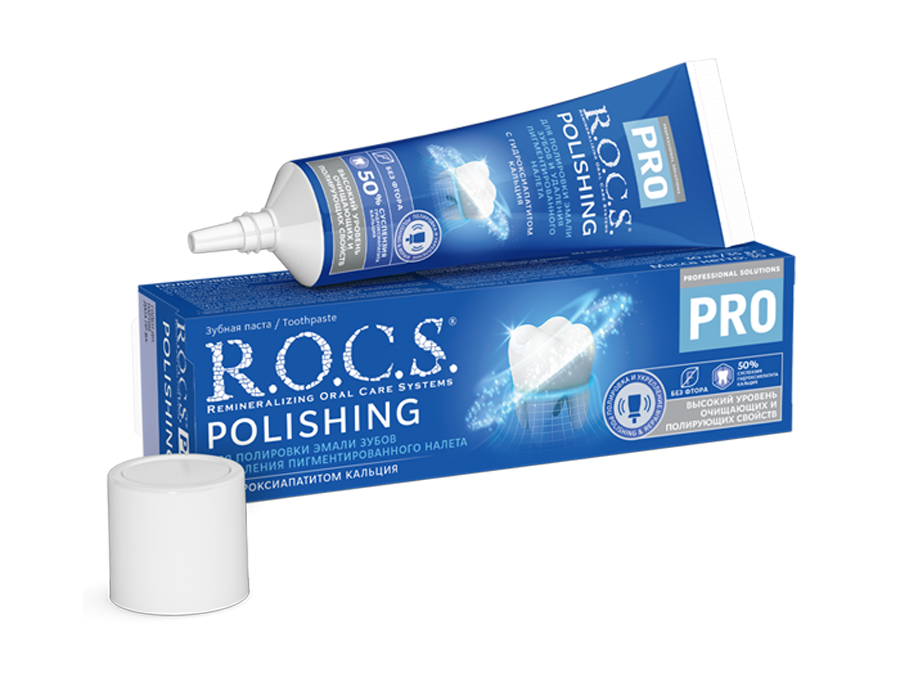
R.O.C.S. PRO POLISHING polishing toothpaste
Description

Active ingredients

Properties

RIA

Clinical trials

Ingredients

Application

Features

R.O.C.S. PRO POLISHING toothpaste has strong cleaning power and handles various types of stained dental plaque. Its PCR (stained pellicle removal) index is 93.

The toothpaste has a high polishing potential thanks to a special abrasive. Ultrafine silica with a particle size of 2–3 microns doesn't scratch treated surfaces.

A 50% hydroxyapatite suspension (7.5% on a dry basis) and calcium glycerophosphate remineralize and strengthen the structures of the hard dental tissues.

Indications

  • PROFESSIONAL USE
    • Suitable for polishing natural teeth as part of professional oral hygiene;
    • Reduces the risk of tooth sensitivity after procedures (scaling, Air Flow, professional tooth whitening, enamel polishing after braces removal).
  • AT-HOME USE
    • Intensive care to maintain the shine and whiteness of teeth.

Organoleptic properties

A white toothpaste with a natural lemon balm flavoring.

 
Ultrafine silica with a particle size of 2–3 microns has enhanced cleaning and polishing properties. Because it contains no large abrasive particles, it doesn't scratch treated surfaces, including esthetic restorations.
 
Multi-sized hydroxyapatite particles occlude dentinal tubules, seal minor fractures and form an insoluble protective layer on the enamel surface thus protecting teeth against irritants.
 
Calcium glycerophosphate (a source of calcium ions and inorganic phosphate) actively remineralizes the enamel.

  • Removes stained plaque.
  • Gives tooth enamel a mirror-like shine.
  • Reduces the risk of tooth hypersensitivity after dental procedures.
  • Doesn't scratch composite restorations.

RIA=30 (Special care)

* Russian Abrasivity Index reflects the cleaning capacity level of oral care products and polishing pastes. Products with a higher RIA value have enhanced cleaning properties, but are also a risk factor for the development of non-carious dental lesions, therefore the choice of toothpaste should be guided by the condition of the hard dental tissues.

Russian Abrasivity Index (RIA): a new stage in oral hygiene standardization

The DRC group of companies, in collaboration with the Institute of Digital Dentistry of the RUDN Medical Institute, has developed and is implementing a new toothpaste abrasivity measurement standard in Russia that meets the highest requirements: safety, accuracy, reproducibility. Принято. This methodology is an alternative to the RDA measurement method and offers a number of advantages. Its effectiveness has been confirmed by a large-scale experimental and clinical study involving 534 patients.

The methodology is based on a rotary machine and digital technologies developed by a research group of dentists, physicists, and digital modeling specialists. QLF diagnostics, intraoral scanning, and digital analysis were used in the work, which made it possible to obtain objective data on tooth wear and the influence of abrasivity over time.


Download RIA research protocol (in Russian):

More detailed information on the Russian Abrasivity Index (RIA)

The toothpaste's abrasivity (RDA) and cleaning properties (PCR) were tested at Indiana University (USA):
Sample No. 12 "R.O.C.S. Dental polishing"

Using R.O.C.S. PRO POLISHING to polish teeth as part of professional oral hygiene reduced tooth hypersensitivity and improved enamel structure in a high-risk group:


Aqua, Glycerin, Silica, Hydroxyapatite, Xanthan Gum, Calcium Glycerophosphate, Polysorbate-20, Aroma, Sodium Lauryl Sulfate, Sodium Methylparaben, Sodium Saccharin, Sodium Benzoate, Sodium Propylparaben, O-Cymen-5-ol, Potassium Hydroxide, Limonene, Citral.

For professional polishing, soft rotating rubber cups (caps) and large-diameter soft end brushes can be used.

For at-home use, use 1–2 times a week instead of your regular toothpaste with a manual or electric toothbrush with soft bristles.

R.O.C.S. PRO POLISHING polishing toothpaste

Polishing toothpaste with hydroxyapatite for professional and at-home use.

Description

Features

R.O.C.S. PRO POLISHING toothpaste has strong cleaning power and handles various types of stained dental plaque. Its PCR (stained pellicle removal) index is 93.

The toothpaste has a high polishing potential thanks to a special abrasive. Ultrafine silica with a particle size of 2–3 microns doesn't scratch treated surfaces.

A 50% hydroxyapatite suspension (7.5% on a dry basis) and calcium glycerophosphate remineralize and strengthen the structures of the hard dental tissues.

Indications

  • PROFESSIONAL USE
    • Suitable for polishing natural teeth as part of professional oral hygiene;
    • Reduces the risk of tooth sensitivity after procedures (scaling, Air Flow, professional tooth whitening, enamel polishing after braces removal).
  • AT-HOME USE
    • Intensive care to maintain the shine and whiteness of teeth.

Organoleptic properties

A white toothpaste with a natural lemon balm flavoring.

Active ingredients

 
Ultrafine silica with a particle size of 2–3 microns has enhanced cleaning and polishing properties. Because it contains no large abrasive particles, it doesn't scratch treated surfaces, including esthetic restorations.
 
Multi-sized hydroxyapatite particles occlude dentinal tubules, seal minor fractures and form an insoluble protective layer on the enamel surface thus protecting teeth against irritants.
 
Calcium glycerophosphate (a source of calcium ions and inorganic phosphate) actively remineralizes the enamel.

Properties

  • Removes stained plaque.
  • Gives tooth enamel a mirror-like shine.
  • Reduces the risk of tooth hypersensitivity after dental procedures.
  • Doesn't scratch composite restorations.

RIA

RIA=30 (Special care)

* Russian Abrasivity Index reflects the cleaning capacity level of oral care products and polishing pastes. Products with a higher RIA value have enhanced cleaning properties, but are also a risk factor for the development of non-carious dental lesions, therefore the choice of toothpaste should be guided by the condition of the hard dental tissues.

Russian Abrasivity Index (RIA): a new stage in oral hygiene standardization

The DRC group of companies, in collaboration with the Institute of Digital Dentistry of the RUDN Medical Institute, has developed and is implementing a new toothpaste abrasivity measurement standard in Russia that meets the highest requirements: safety, accuracy, reproducibility. Принято. This methodology is an alternative to the RDA measurement method and offers a number of advantages. Its effectiveness has been confirmed by a large-scale experimental and clinical study involving 534 patients.

The methodology is based on a rotary machine and digital technologies developed by a research group of dentists, physicists, and digital modeling specialists. QLF diagnostics, intraoral scanning, and digital analysis were used in the work, which made it possible to obtain objective data on tooth wear and the influence of abrasivity over time.


Download RIA research protocol (in Russian):

More detailed information on the Russian Abrasivity Index (RIA)

Clinical trials

The toothpaste's abrasivity (RDA) and cleaning properties (PCR) were tested at Indiana University (USA):
Sample No. 12 "R.O.C.S. Dental polishing"

Using R.O.C.S. PRO POLISHING to polish teeth as part of professional oral hygiene reduced tooth hypersensitivity and improved enamel structure in a high-risk group:
Ingredients

Aqua, Glycerin, Silica, Hydroxyapatite, Xanthan Gum, Calcium Glycerophosphate, Polysorbate-20, Aroma, Sodium Lauryl Sulfate, Sodium Methylparaben, Sodium Saccharin, Sodium Benzoate, Sodium Propylparaben, O-Cymen-5-ol, Potassium Hydroxide, Limonene, Citral.

Application

For professional polishing, soft rotating rubber cups (caps) and large-diameter soft end brushes can be used.

For at-home use, use 1–2 times a week instead of your regular toothpaste with a manual or electric toothbrush with soft bristles.