Description
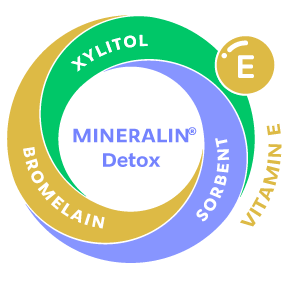
Active ingredients
Properties
RIA
Clinical trials
Ingredients
Application
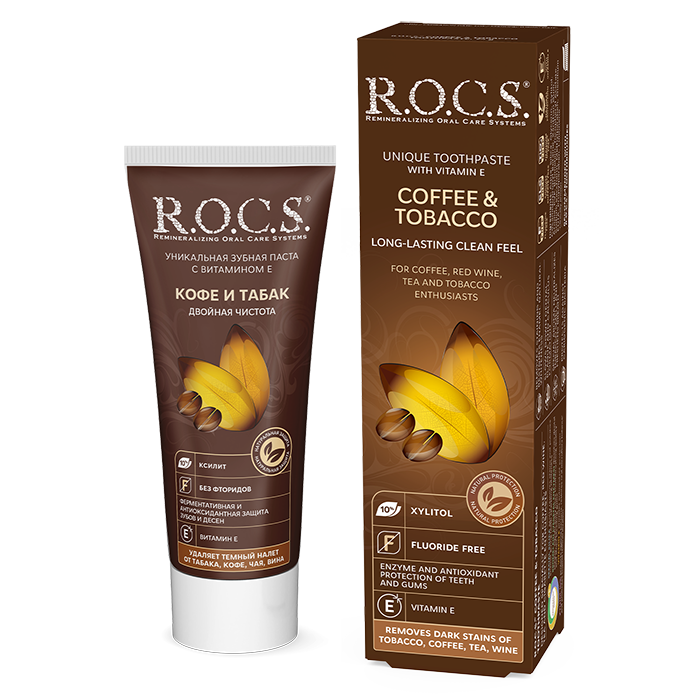
R.O.C.S. Coffee and Tobacco toothpaste was developed with the specific pathological processes of a smoker's oral cavity in mind. It delivers a high level of comprehensive protection for teeth and gums. With medium abrasivity, it gently removes surface stains, restoring the enamel's natural whiteness, and slows the formation of dental plaque and tartar. Its multi-component flavor neutralizes the smell of tobacco smoke.
A cream-colored toothpaste with a refreshing mint flavor. Contains no artificial colorants.
* Russian Abrasivity Index reflects the cleaning capacity level of oral care products and polishing pastes. Products with a higher RIA value have enhanced cleaning properties, but are also a risk factor for the development of non-carious dental lesions, therefore the choice of toothpaste should be guided by the condition of the hard dental tissues.
The DRC group of companies, in collaboration with the Institute of Digital Dentistry of the RUDN Medical Institute, has developed and is implementing a new toothpaste abrasivity measurement standard in Russia that meets the highest requirements: safety, accuracy, reproducibility. Принято. This methodology is an alternative to the RDA measurement method and offers a number of advantages. Its effectiveness has been confirmed by a large-scale experimental and clinical study involving 534 patients.
The methodology is based on a rotary machine and digital technologies developed by a research group of dentists, physicists, and digital modeling specialists. QLF diagnostics, intraoral scanning, and digital analysis were used in the work, which made it possible to obtain objective data on tooth wear and the influence of abrasivity over time.
More detailed information on the Russian Abrasivity Index (RIA)Bromelain toothpaste has been proven to reduce bacterial adhesion and, as a result, slow the rate of dental plaque formation:
The present study aimed to evaluate the effect of R.O.C.S. enzyme-containing toothpaste with bromelain and xylitol on the adhesion of microorganisms in the human oral cavity. A positive control was created using R.O.C.S. toothpaste with xylitol, but without the enzyme.
Anti-adhesive activity was studied using a culture of human embryonic musculocutaneous fibroblasts.
The test microorganism cultures were clinical strains of microorganisms isolated from the oral cavities of volunteers: Staphylococcus aureus, Streptococcus salivarius, Streptococcus sanguis and Streptococcus sobrinus.
A sample of the toothpaste at a dilution of 1:20,000 (in the presence of 50% human serum) and a culture of the test strain at a dose of 10⁸ KOU/ml were added to the cell culture and incubated at 37 °C. After incubation, the monolayer cells were washed to remove unattached bacteria by repeatedly changing the Eagle's medium. The cells were then fixed with ethyl alcohol, stained with Romanowsky-Giemsa, and examined under a microscope.
The degree of microbial adhesion was determined by the microbial load relative to the control, which was taken as 100%.
The study was carried out using the blind method. All studies were carried out three times.
After three minutes of incubation, which corresponds to the duration of normal tooth brushing, the suppression of adhesion was as follows:
However, when the exposure time was increased to 2 hours, the anti-adhesive efficacy decreased significantly. This seems to be due to the adhesion becoming reversible shortly after the strains were introduced into the model system, as adhesion usually becomes irreversible after 1–2 hours.
Fig. 1. Control fibroblast cells
Fig. 2. Cells + Str. salivarius
Fig. 3. Cells + S. salivarius + bromelain paste
(exposure 2h.)
Fig. 4. Cells + Str.salivarius + paste with bromelain
(exposure 3 min.)
Anti-inflammatory activity of bromelain:
Toothpastes containing antiseptic substances such as triclosan, chlorhexidine, aluminium and zinc salts are among the hygiene products capable of inhibiting plaque formation. However, their high antimicrobial activity can lead to oral dysbacteriosis with long-term use, reducing the effectiveness of treatment. An alternative are hygiene products whose antimicrobial action is realised due to enzyme-containing components.
Over a period of two months, 40 patients, aged 18–36 years and of both sexes, with chronic catarrhal gingivitis were examined. The patients were randomly divided into two groups:
Within each group, two subgroups were identified according to the toothbrush used:
The toothpaste studies were conducted using a double-blind method. Repeated examinations, including an assessment of indices and diagnostic tests, were carried out after one and two weeks and again after one and two months.
Following the initial visual examination and calculation of the indices, it was found that acute and chronic catarrhal gingivitis of a mild degree were predominant in both groups.
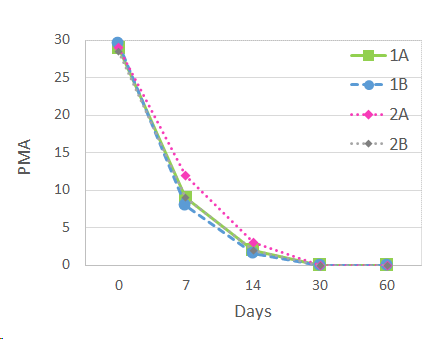
As early as the 14th day of the study, PMA index values decreased from 29.5% to 2% and 1.5% in subgroups A and B, respectively. In group 2, the index values decreased to 3% and 2% (see Fig. 4). The best results in subgroup B were due to the use of a soft toothbrush.
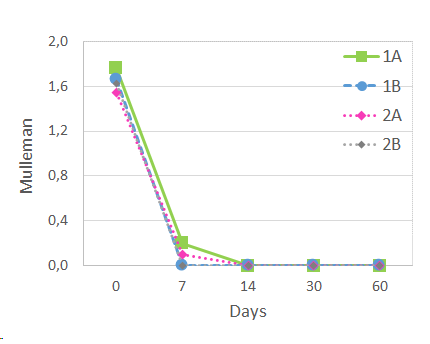
Bleeding disappeared in all subjects, indicating the achievement of an anti-inflammatory effect in periodontal tissues (Fig. 3).
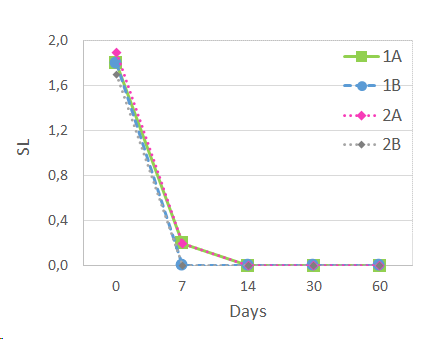
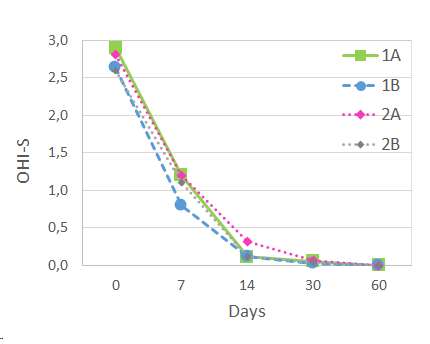
Fig. 1. Level of oral hygiene
Fig. 2. Amount of plaque in the gingival region
Fig. 3. Bleeding index
Fig. 4. Gingivitis severity score
The study of the effect of enzyme-containing toothpastes on the initial forms of inflammatory periodontal diseases, characterised by an increased tendency to plaque formation, confirmed their high efficiency.
With regular brushing using a soft brush, a pronounced anti-inflammatory effect on the periodontium was observed within a week.
After two weeks of using R.O.C.S. toothpaste, significant improvements in oral hygiene and a pronounced anti-inflammatory effect were observed, as evaluated by hygiene indices and PMA.
At the follow-up examination after two months, no deterioration in the results was observed in either group.
No cases of local irritation or allergic reactions to the oral mucosa were recorded during the entire application period.
Aqua, Silica, Glycerin, Xylitol, Cocamidopropyl Betaine, Xanthan Gum, Aroma, PVP, Bromelain, Tocopheryl Acetate, Sodium Saccharin, Methylparaben, Disodium EDTA, Propylparaben, Limonene.
Use twice a day (morning and evening). Recommended toothbrushing time is 2-3 minutes.
Suitable for all ages, with no time restrictions on use.
For better removal of dark plaque, use together with the R.O.C.S. SMOKERS toothbrush.

R.O.C.S. Coffee and Tobacco toothpaste was developed with the specific pathological processes of a smoker's oral cavity in mind. It delivers a high level of comprehensive protection for teeth and gums. With medium abrasivity, it gently removes surface stains, restoring the enamel's natural whiteness, and slows the formation of dental plaque and tartar. Its multi-component flavor neutralizes the smell of tobacco smoke.
A cream-colored toothpaste with a refreshing mint flavor. Contains no artificial colorants.
* Russian Abrasivity Index reflects the cleaning capacity level of oral care products and polishing pastes. Products with a higher RIA value have enhanced cleaning properties, but are also a risk factor for the development of non-carious dental lesions, therefore the choice of toothpaste should be guided by the condition of the hard dental tissues.
The DRC group of companies, in collaboration with the Institute of Digital Dentistry of the RUDN Medical Institute, has developed and is implementing a new toothpaste abrasivity measurement standard in Russia that meets the highest requirements: safety, accuracy, reproducibility. Принято. This methodology is an alternative to the RDA measurement method and offers a number of advantages. Its effectiveness has been confirmed by a large-scale experimental and clinical study involving 534 patients.
The methodology is based on a rotary machine and digital technologies developed by a research group of dentists, physicists, and digital modeling specialists. QLF diagnostics, intraoral scanning, and digital analysis were used in the work, which made it possible to obtain objective data on tooth wear and the influence of abrasivity over time.
More detailed information on the Russian Abrasivity Index (RIA)Bromelain toothpaste has been proven to reduce bacterial adhesion and, as a result, slow the rate of dental plaque formation:
The present study aimed to evaluate the effect of R.O.C.S. enzyme-containing toothpaste with bromelain and xylitol on the adhesion of microorganisms in the human oral cavity. A positive control was created using R.O.C.S. toothpaste with xylitol, but without the enzyme.
Anti-adhesive activity was studied using a culture of human embryonic musculocutaneous fibroblasts.
The test microorganism cultures were clinical strains of microorganisms isolated from the oral cavities of volunteers: Staphylococcus aureus, Streptococcus salivarius, Streptococcus sanguis and Streptococcus sobrinus.
A sample of the toothpaste at a dilution of 1:20,000 (in the presence of 50% human serum) and a culture of the test strain at a dose of 10⁸ KOU/ml were added to the cell culture and incubated at 37 °C. After incubation, the monolayer cells were washed to remove unattached bacteria by repeatedly changing the Eagle's medium. The cells were then fixed with ethyl alcohol, stained with Romanowsky-Giemsa, and examined under a microscope.
The degree of microbial adhesion was determined by the microbial load relative to the control, which was taken as 100%.
The study was carried out using the blind method. All studies were carried out three times.
After three minutes of incubation, which corresponds to the duration of normal tooth brushing, the suppression of adhesion was as follows:
However, when the exposure time was increased to 2 hours, the anti-adhesive efficacy decreased significantly. This seems to be due to the adhesion becoming reversible shortly after the strains were introduced into the model system, as adhesion usually becomes irreversible after 1–2 hours.
Fig. 1. Control fibroblast cells
Fig. 2. Cells + Str. salivarius
Fig. 3. Cells + S. salivarius + bromelain paste
(exposure 2h.)
Fig. 4. Cells + Str.salivarius + paste with bromelain
(exposure 3 min.)
Anti-inflammatory activity of bromelain:
Toothpastes containing antiseptic substances such as triclosan, chlorhexidine, aluminium and zinc salts are among the hygiene products capable of inhibiting plaque formation. However, their high antimicrobial activity can lead to oral dysbacteriosis with long-term use, reducing the effectiveness of treatment. An alternative are hygiene products whose antimicrobial action is realised due to enzyme-containing components.
Over a period of two months, 40 patients, aged 18–36 years and of both sexes, with chronic catarrhal gingivitis were examined. The patients were randomly divided into two groups:
Within each group, two subgroups were identified according to the toothbrush used:
The toothpaste studies were conducted using a double-blind method. Repeated examinations, including an assessment of indices and diagnostic tests, were carried out after one and two weeks and again after one and two months.
Following the initial visual examination and calculation of the indices, it was found that acute and chronic catarrhal gingivitis of a mild degree were predominant in both groups.
As early as the 14th day of the study, PMA index values decreased from 29.5% to 2% and 1.5% in subgroups A and B, respectively. In group 2, the index values decreased to 3% and 2% (see Fig. 4). The best results in subgroup B were due to the use of a soft toothbrush.
Bleeding disappeared in all subjects, indicating the achievement of an anti-inflammatory effect in periodontal tissues (Fig. 3).
Fig. 1. Level of oral hygiene
Fig. 2. Amount of plaque in the gingival region
Fig. 3. Bleeding index
Fig. 4. Gingivitis severity score
The study of the effect of enzyme-containing toothpastes on the initial forms of inflammatory periodontal diseases, characterised by an increased tendency to plaque formation, confirmed their high efficiency.
With regular brushing using a soft brush, a pronounced anti-inflammatory effect on the periodontium was observed within a week.
After two weeks of using R.O.C.S. toothpaste, significant improvements in oral hygiene and a pronounced anti-inflammatory effect were observed, as evaluated by hygiene indices and PMA.
At the follow-up examination after two months, no deterioration in the results was observed in either group.
No cases of local irritation or allergic reactions to the oral mucosa were recorded during the entire application period.
Aqua, Silica, Glycerin, Xylitol, Cocamidopropyl Betaine, Xanthan Gum, Aroma, PVP, Bromelain, Tocopheryl Acetate, Sodium Saccharin, Methylparaben, Disodium EDTA, Propylparaben, Limonene.
Use twice a day (morning and evening). Recommended toothbrushing time is 2-3 minutes.
Suitable for all ages, with no time restrictions on use.
For better removal of dark plaque, use together with the R.O.C.S. SMOKERS toothbrush.