Xerostomia

A moist mucous membrane is one of the main factors in maintaining its normal homeostasis and protecting it from inflammation and the penetrating action of pathogens, including viruses. One of the most important functions of saliva is to maintain the integrity of tooth enamel. Saliva not only contains all the necessary structural minerals, but also a delivery system (proteins and enzymes) that ensures their penetration into the enamel.

According to various estimates, more than 20% of the world's population experiences discomfort caused by dry mouth. This percentage is even higher among the elderly and women.

Dry mouth leads to disruption of the tooth remineralisation process, multiple carious and erosive lesions of the teeth, and inflammatory diseases of the gums and nasopharynx. Saliva deficiency causes a shift in the natural balance of the oral microflora and the development of dysbacteriosis.

Confusion in terminology and difficulties in diagnosis

Xerostomia is a subjective sensation of dry mouth, which can be the result of both a decrease in saliva flow (hyposalivation) and a change in its quality, for example, under the influence of changes in blood plasma composition.

Quite often, patients are unaware of the presence of the condition. Therefore, special questionnaires are used to determine the presence of xerostomia.


Symptoms of xerostomia
(sample patient questionnaire):

  • Difficulty swallowing and chewing dry food
  • Sensitivity to spicy food
  • Salty, bitter and metallic taste in the mouth
  • Burning sensation
  • Absence (or reduction) of taste perception. Taste inversions
  • Discomfort in the salivary glands
  • Coughing episodes
  • Voice changes, speech difficulties
  • Increased fluid intake
  • Night-time discomfort

Hyposalivation is a decrease in saliva secretion. The secretory function of the salivary glands is assessed using sialometry, but signs of hyposalivation can be detected during a dental examination.


Signs of hyposalivation during patient examination:

  • Dry, cracked, flaky lips with crusts
  • Dry, folded and erythematous tongue, absence or hypertrophy of papillae
  • Cracks in the corners of the mouth
  • Caries, cervical or atypical (e.g. in the incisal edge, lingual surfaces and cusps)
  • Enamel erosion
  • Enlargement of the salivary glands
  • Mucositis
  • Oral candidiasis
  • Aphthous/herpetic stomatitis

Causes of dry mouth

Decreased saliva secretion is not necessarily associated with salivary gland disease. Xerostomia is a symptom of certain diseases and pathological conditions:

Autoimmune diseases Rheumatoid arthritis, systemic lupus erythematosus, systemic sclerosis, mixed connective tissue disease
Endocrine changes and diseases Menopause, andropause, type 1 and 2 diabetes
Infectious diseases that lead to dehydration Mumps, HIV, Covid-19
Инфекционные заболевания, приводящие с дегидратации организма Influenza, rotavirus, etc.
Other conditions Radiation therapy, chronic active hepatitis, graft-versus-host disease, renal dialysis, depression

Medications are often the cause of discomfort in the mouth. Many of the world's best-selling drugs have xerostomia as a side effect. These include antihistamines, antihypertensives, antidepressants, anticholinergics, antipsychotics, sedatives, analgesics, muscle relaxants, diuretics, anticonvulsants, etc. Download the PDF file to see the full list of INNs for these drugs.

In addition, perfectly healthy people periodically experience a sharp feeling of dry mouth during increased speech and physical exertion, or in a state of stress.

An effective solution from R.O.C.S.

The high demand for specialised hygiene products for patients with hyposalivation and xerostomia prompted us to create an innovative product – R.O.C.S. PRO Moisturising toothpaste. Its patented formula has been tested repeatedly in clinical practice and has proven to be highly effective.

R.O.C.S. PRO Moisturizing toothpaste
Mechanism of action and active ingredients

MUCOSA PROTECTION PRO-SYSTEM

The active ingredients in toothpaste work together to provide a more pronounced preventive effect than each component individually, creating a moisture-retaining protective layer on the surface of the mucous membrane and reducing the risk of inflammatory processes in the oral cavity.

 
Alginate is a polysaccharide derived from seaweed that retains moisture on the surface of the mucous membrane, absorbs toxins, prevents the attachment of pathogenic bacteria and fungi, and supports reparative processes.
 
Xylitol suppresses the activity of cryogenic bacteria and some periodontal pathogens, and prevents the adhesion of the fungus Candida.
 
Bromelain is a proteolytic enzyme that prevents microbial adhesion, has anti-inflammatory properties, and facilitates the removal of dental plaque.
 
Extracts of Japanese honeysuckle and honeysuckle flowers have a broad spectrum of antimicrobial activity, inhibit reactions induced by lipopolysaccharides, and have a tissue-protective effect.
 
The special OPTAFLOW aromatic composition gently stimulates salivation and gently refreshes the oral cavity without causing a burning sensation.

A comprehensive approach: why it is important for patients with hyposalivation to strengthen their enamel

One of the most important functions of saliva is to maintain homeostasis and the integrity of tooth enamel. Saliva not only contains all the necessary structural minerals, but also a delivery system (proteins and enzymes) that ensures their penetration into the enamel. A lack of saliva significantly increases the risk of dental diseases (caries, erosion, etc.).

R.O.C.S. Medical Minerals remineralising gel increases enamel mineralisation, strengthens its structure and protects teeth from decay, even with reduced saliva secretion

In combination with the remineralising gel, the use of R.O.C.S. PRO Moisturising allows most of the natural functions of saliva to be corrected.
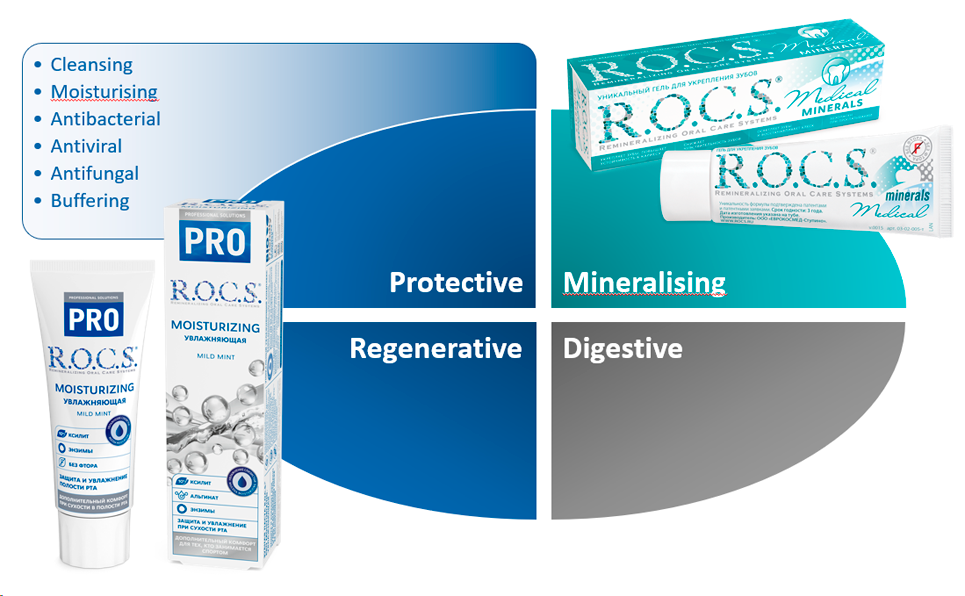
Correction of saliva functions in cases of hyposalivation

Recommendations for doctors treating patients with xerostomia

  • During the initial consultation:
    • Antibacterial + fungicidal + replacement therapy to restore microbial balance;
    • Selection of individual hygiene products (toothpastes, rinses and sprays with a moisturising effect);
    • Teaching the patient proper toothbrushing technique.
  • Subsequent visits:
    • A course of remineralising therapy 4 times a year;
    • Quarterly preventive examination;
    • Adjustment of the treatment plan if necessary.
PREVENTIVE ORAL CARE PLAN
for patients with xerostomia
  1. Specialised toothpaste

R.O.C.S. PRO Moisturizing

Use twice a day (morning/evening).

 
  1. Soft toothbrush

R.O.C.S. PRO 5940 toothbrush.

If there is damage to the mucous membrane, it is recommended to use extra-soft R.O.C.S. SENSITIVE or R.O.C.S. PRO SENSITIVE toothbrushes.

 
  1. Remineralising gel

Any gel from the R.O.C.S. Medical Minerals series.

Apply the gel once a day before bedtime.

 
  1. Alcohol-free mouthwash

R.O.C.S. mouthwashes with plant extracts, minerals and xylitol.

Use throughout the day as needed.